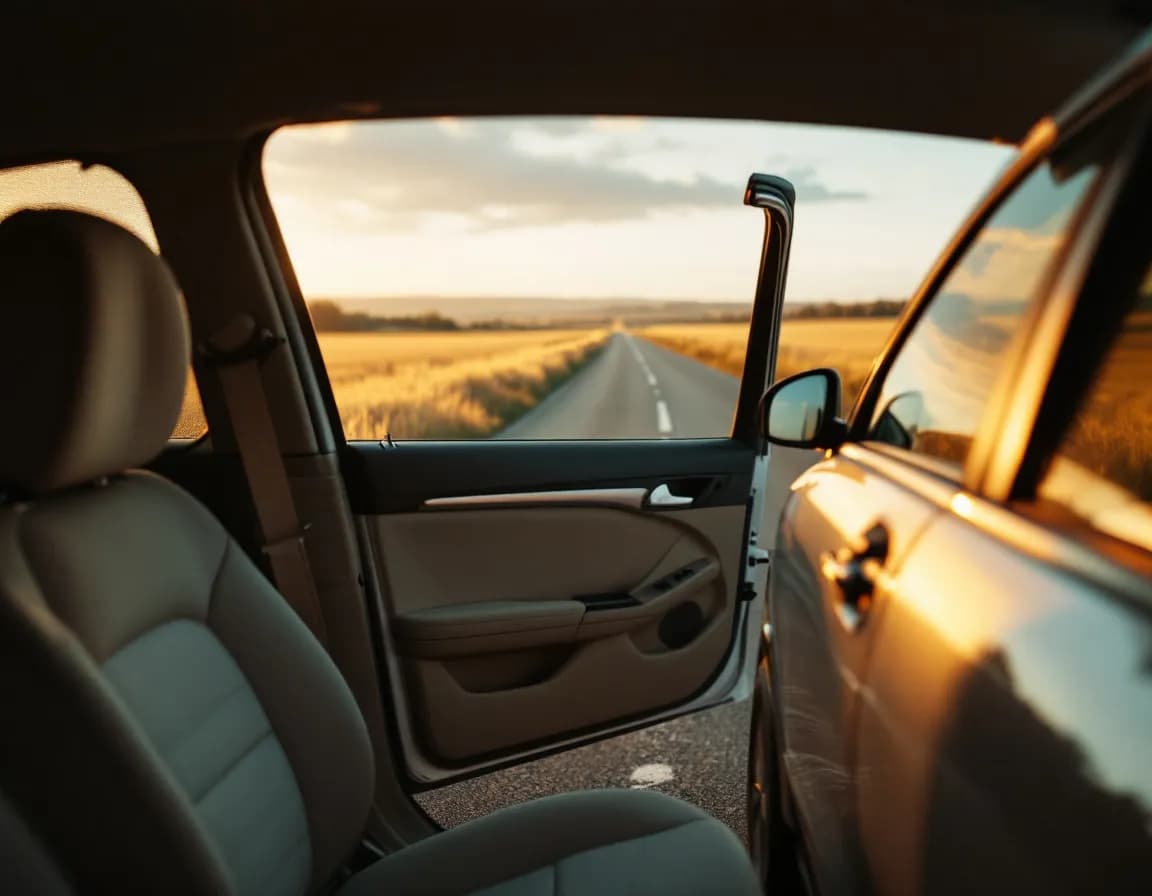
A driving seat is a chair with three extra problems. It vibrates, you cannot get up when you feel like it, and one foot is doing a job.
Everything written for desk workers half applies. Here is the version that accounts for the rest.
What driving adds to ordinary sitting
You cannot shift position. A desk worker fidgets, crosses their legs, leans back. A driver holds roughly one shape because the controls require it.
The hips are often lower than the knees. Many car seats tip you backwards, which rounds the lower back more than an office chair does.
The arms are forward and up. Holding a wheel is a sustained low-level job for the shoulders and the upper back.
One leg works, one rests. Right-foot pedal work over hours is asymmetric, and asymmetry is usually what you feel first.
The underlying mechanism is the same as any long sit, which we covered in stretching when you sit all day. The difference is the lack of interruptions.
The seven, beside the vehicle
All upright. No floor, no mat, about a square metre. You can do these in a lay-by, a service station or a yard without attracting attention.
- Chin-to-Chest. Let your head drop forward, chin towards the chest. Thirty seconds. Gravity does it; do not pull.
- Neck Rotation. Turn slowly to look over each shoulder. Thirty seconds each side. The mirror-checking side is usually the stiffer one.
- Overhead Triceps Stretch. One hand down your back, the other gently drawing the elbow. Thirty seconds each side.
- Chest Opener. Hands clasped behind you, shoulder blades together, chest lifting. Forty seconds. This is the direct answer to hours of holding a wheel.
- Standing Figure-Four. Cross one ankle over the opposite knee and sit back as if into a chair, holding the vehicle for balance. Thirty seconds each side.
- Standing Forward Fold. Feet hip width, soft knees, fold from the hip and let your head hang. Forty seconds.
- Ankle Circles. One foot up, slow circles both ways. Forty seconds each side. Do the pedal foot first, and expect it to feel different.
That is about five minutes. If you have two, do the chest opener, the standing figure-four and the forward fold.
The hip flexors are the part driving cannot reach
Every stretch above works upright, which is what makes them practical. But a standing figure-four gets the outside of the hip, not the front.
The front of the hip, the part that a seat holds folded all shift, needs you to extend the hip. That means a lunge, which means a knee on the ground or a long split stance. If you have a verge, a mat or a quiet corner at the end of a shift, a low lunge with the tailbone tucked under is the single most relevant stretch for anyone who drives for a living. We wrote about that in tight hips from sitting all day.
During the shift
The stretching matters less than the breaks, which is an unsatisfying thing for a stretching app to say and still true.
Get out of the seat whenever you legitimately stop. Thirty seconds of standing changes the joint angle, and the joint angle is the whole mechanism. Alternate which hand rests on the wheel where it is safe to do so. And set the seat so your hips are not lower than your knees, if the vehicle allows it.
When to stop, and when to ask someone
Stretching is general fitness, not treatment. Stop anything that causes pain, pins and needles, numbness or dizziness.
A few things want a professional rather than a stretch: pain travelling below the knee, numbness in a foot, weakness anywhere, or anything that developed after a collision however minor. If you drive for a living, that is your livelihood, and getting it looked at early is the sensible call. Our fitness and safety note covers the rest.
Never stretch while driving, and do not do balance work on a live forecourt.
Where Lucy fits
Lucy is an iPhone app of short guided stretching routines for people who sit all day. Nowhere to Lie Down is six minutes and ten stretches, every one of which works standing in about a square metre. It is the closest match to this list and it was built for exactly this problem.
Three of the app's sixteen routines need no floor at all. The timer counts each hold and tells you when to switch sides, so you are not watching a clock in a lay-by. It works offline, which matters more in a vehicle than at a desk.
One routine is free in full. The rest is a subscription with a 7-day free trial, priced in your own currency on the App Store.
FAQ
What stretches should truck drivers do?
Upright ones, because the floor is rarely an option. The chest opener, standing figure-four and standing forward fold cover the three areas a long shift affects most: the front of the shoulders, the outside of the hip and the back of the legs.
How often should you stop and stretch on a long drive?
Whenever you legitimately stop, and stand up for at least thirty seconds each time even if you do not stretch. Changing the joint angle is the mechanism; the stretches are the bonus.
Why does my lower back ache after driving?
A long sit holds the lower back rounded, and many vehicle seats tip the hips below the knees, which increases that. Whether that explains your own back is a question for a professional, not a web page.
Can you stretch in the cab?
Neck rotations, a chin-to-chest and shoulder rolls all work in the seat when you are parked. Anything involving the hips or hamstrings needs you out of it. Never stretch while the vehicle is moving.
Does a seat cushion help?
It changes the shape of your sitting rather than the duration, and duration is the part that matters. Setting the seat so your hips are not below your knees is usually the more useful adjustment.
Lucy has a standing routine for this, built for a square metre beside the car.